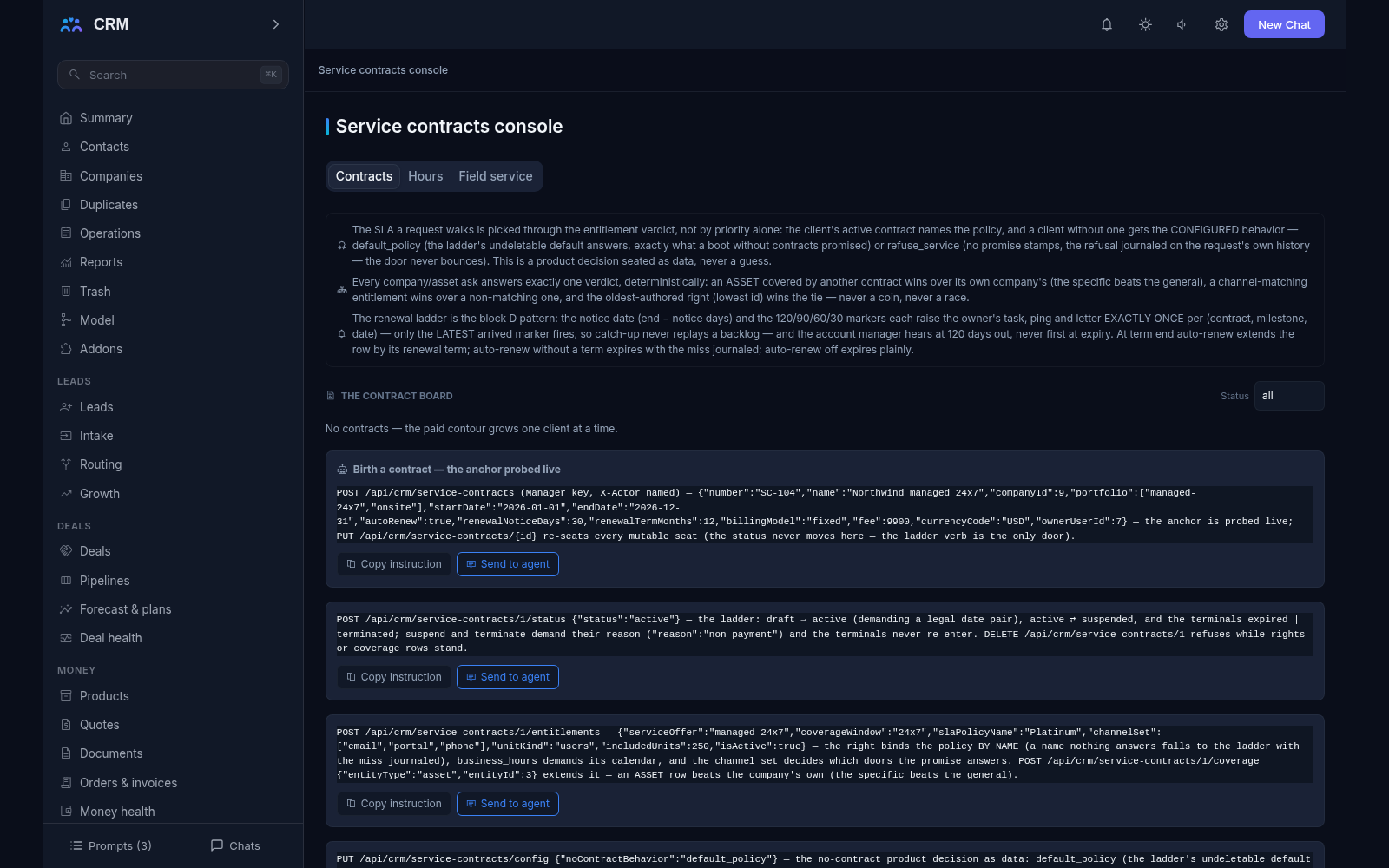
The add-on Contracts keeps service contracts: what service level each customer bought, for which sites and equipment, with which response times and until what date. It reminds you about renewal, tracks prepaid hour balances, computes credits for missed deadlines and schedules field visits. The work is gathered in the Service contracts console with the tabs Contracts, Hours and Field service.
Why you need it
A customer bought a “gold” level with a one-hour response, and support does not know it: deadlines are set by the general policy and the promise is quietly broken. Prepaid hours are deducted by eye or not at all, a contract expires without anyone noticing, and renewal is discussed after the term has ended. Equipment at customer sites lives in someone’s notebook, and planned maintenance is remembered only when something breaks.
Contracts close all of this at once. A customer’s request deadlines start counting against the policy they actually bought, prepaid hours are deducted only by approved entries and never go below zero, and the owner hears about renewal months in advance rather than on the last day. The same figures are visible to the customer, so the office and the client read one truth.
What it does
- The contract itself. A contract row holds the customer company, a seat for the invoice in the money contour, the portfolio of offers, the gated ladder draft, active, suspended, expired or terminated, the date pair with its auto-renew, notice and term seats, and the billing model with the fee digits kept as data — money moves through money-contour documents when it moves.
- The right to a service level. One offer from the portfolio binds to one SLA policy by name, together with the coverage-window words, the channel set (which doors the promise answers) and the included units by kind.
- Who and what is covered. Coverage is listed by asset, site, user or the whole company. The specific beats the general: an asset covered by contract B answers B’s right even while its company holds contract A.
- The verdict the deadline ladder reads. For a company, and optionally for a specific asset, the product names the policy of the covering contract’s best right — a channel-matching right preferred, the oldest breaking a tie. A suspended or expired contract answers the no-contract behaviour you configured, with its reason riding the verdict. With no contract at all it answers the configured word: “default policy” (exactly what the fallback promised without this add-on, said aloud) or “refuse service”, where no clock is stamped at all and the refusal is journaled on the request’s history without bouncing the request.
- There is no silent substitution. If no standing enabled row answers the named policy, the request goes to the general ladder, and the miss is written to the journal — the product will not guess.
- Renewal starts early. The milestones at 120, 90, 60 and 30 days work around the end date, and each one raises the owner’s task, an in-app ping and a letter exactly once per contract and milestone — only the latest arrived milestone fires, so the account manager hears at 120 days rather than at expiry. An auto-renew contract extends by its own renewal months; without it the contract expires and the miss is journaled aloud.
- Prepaid hours. Hours are kept in pools, and the carry-over word decides the leftover’s fate: “lose” lets it die, “carry” hands it to the successor pool at its birth. A pool has a low-balance threshold (two hours by default), and one pool breathes at a time per contract, so a deduction is always unambiguous.
- The kind of work decides what burns. Remote, onsite and travel debit the pool whose window covers the worked moment. Project work never deducts anything — it is separate work, not service.
- Deduction only after approval. Only an approved time entry reduces the balance — exactly once, never below zero, with an overdraw refused by name. The approved row becomes frozen evidence the ledger reconciles against, and the used figure is always derived from the approved deducting entries inside the pool’s window, never kept as a counter that could drift.
- The low-balance warning. The first time the remainder crosses the threshold, the owner receives a notification and a letter — once. A top-up arms the ladder again.
- The “engineers forget to log” report. Beside it stand resolved requests without time entries and unapproved entries older than the window — you can see where the hour accounting has fallen behind the work.
- One figure for the office and the client. The hours report the client sees reads the same aggregate figures as the office, with the missed-deadline facts beside them. One metric — two interfaces, and no room for a disagreement.
- Credits for missed deadlines. The number of breaches is taken from the journal, and the amount is computed by the rate written into the contract. A credit is proposed first, and a person closes it — one row per contract and period. Nothing is accrued by itself.
- Sites. These are the company’s addresses with a time zone, a work window and the list of people on site. A field request cannot even be created without a site: without an address and a window a visit is a wish, not a plan. A dead reference to a site refuses by name.
- Equipment — a thin link to the registry. One row is created per asset with a reference to the asset registry: the site, the replacement group, the coverage and the date of the last service. No second registry appears.
- A visit counts three spans of time. Reaction, arrival and restoration are counted separately, each against its own target time, and are never blended into one number. Every stamp is set once at the visit’s birth, over the working calendar the contract’s verdict named; rescheduling the visit never recomputes the promise.
- Checklists do not let the work be closed half-done. A matching template is demanded, every mandatory item, a photo where one is required, and the client’s signature where the template says so. An unmet rule refuses the completion and names what exactly is missing.
- The travel time and the on-site time. At the visit’s completion these spans are written as unapproved entries against the covering contract. Deducting hours is still something only an approval can do — one rule for the whole accounting.
- Planned maintenance. Plans are set by interval. The daily pass creates exactly one visit per arrived date, and a repeated pass doubles nothing. If several dates have accumulated, the oldest is taken — one per pass. A refused visit is recorded, and the plan stays in the missed-maintenance report until a person fixes the cause. The next date after a visit is set a full interval ahead.
How it relates to other add-ons
Contracts stand on three add-ons: Service, SLA and ITSM. The first provides the requests, the second the deadline policies and the working calendars, the third the asset registry over which the coverage is set. The add-on catalog will not let you tick contracts until all three are installed: there is nothing to promise a service level with if everything around is empty.
The link works in both directions. Before counting a request’s deadline, SLA asks Contracts for a verdict: if the company has an active contract with a right to a policy, the deadline is set by that policy, not by the general one. Without the contracts add-on this question is answered honestly by the fallback — the general policy — and support works exactly as it promised originally.
Honest limits
- There are no rate cards, and a credit is not settled automatically through invoices: the amount is proposed and a person decides.
- Offline mobile work, a parts warehouse, a replacement fund, a dispatch board, geo-routing and a per-geography cost report are named deferrals.
- Equipment does not become a second registry: a row references an asset from the ITSM registry and keeps no inventory of its own.
- Preventive maintenance runs strictly by interval; calendar rules such as “every second Sunday” are not built.
- A visit’s promise is fixed when the visit is born and is not recomputed by a reschedule — a deliberate decision, because otherwise a promise could be “fixed” simply by moving the visit.
- When a checklist template requires no photos, the gate degrades to ordinary checkboxes.
All add-ons → Add-ons catalogue