The add-on Messaging keeps the dialogues that happen in short messages — SMS, WhatsApp, Telegram and other messengers — right next to email and calls. Customers write where it is convenient for them, the team answers from one screen, and outgoing messages respect consents and budgets. There is no second messaging stack inside the product: the add-on rides the same send rail, consent machinery and stop lists your email campaigns already use.
Why you need it
Customers stopped writing long letters a while ago: a short message is faster and more familiar. But a messenger dialogue that lives on an employee’s personal phone does not belong to the company — the day that person leaves, the history leaves with them. Messages sent in bulk from a personal number raise two questions nobody can answer: who actually agreed to receive them, and how much did they cost? And when a customer complains about spam, there is neither a consent nor a log to show.
Messaging moves this correspondence into the CRM and makes it manageable. Answers go out from a shared place, consents and opt-outs are handled automatically, and every outgoing message passes its checks before it leaves. You see not only “sent”, but what it cost and why some messages did not go out at all.
What it does
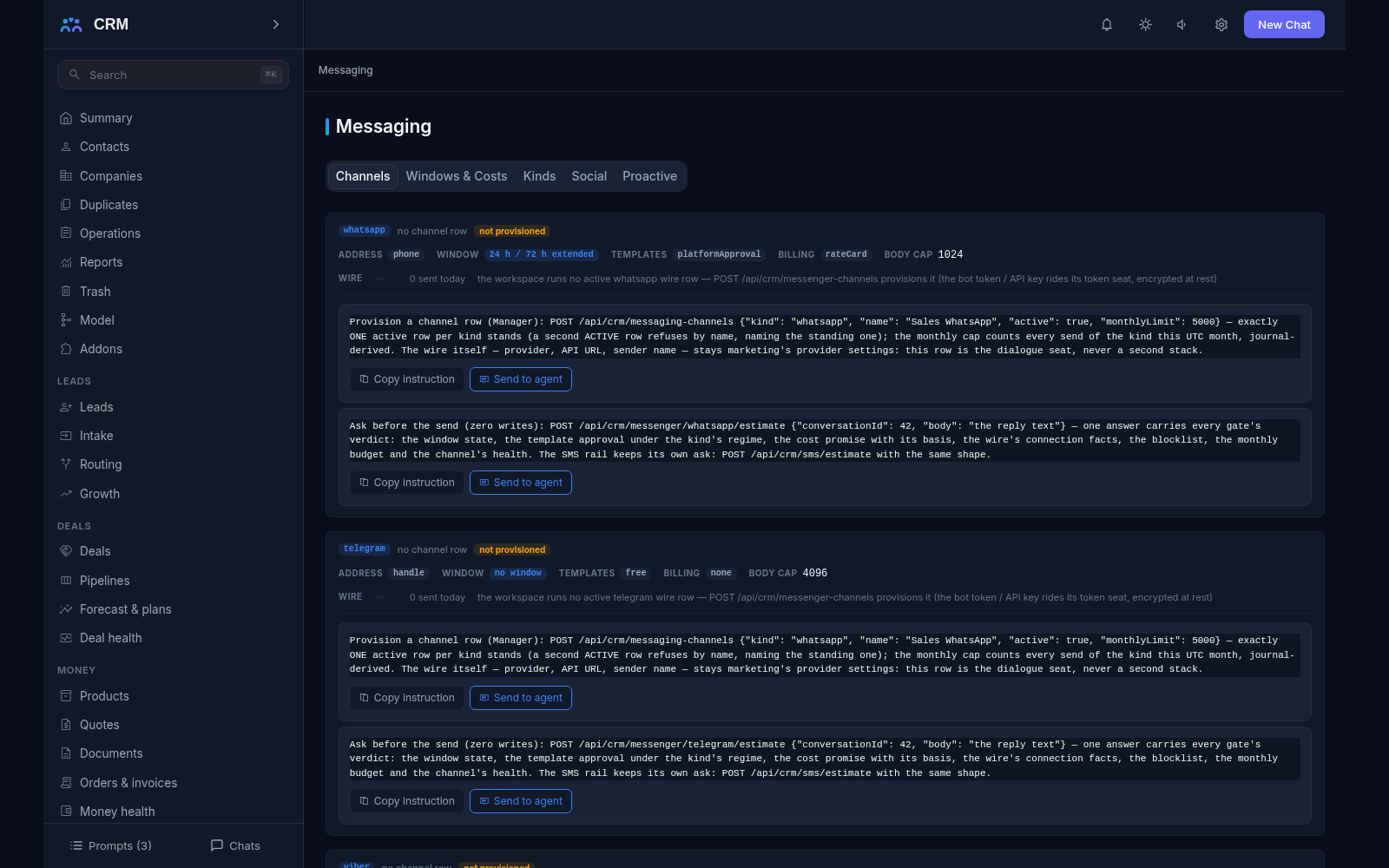
- Channels are settings, not separate programs. WhatsApp, Telegram and Viber are assembled from one set of rules: what an address looks like, whether there is a reply window, whether approved templates are needed, which consent topic the client’s consent belongs to, how the cost is calculated and how long a message may be. A channel is “switched on” by a setting — adding a new kind can be done with data, without rewriting the product.
- A reply inside the conversation. The customer wrote first — you answer with free text right in the dialogue. The customer’s opt-out from mailings (a short “STOP”, for example) stops mass propositions but not the answer to their own request: support must not fall silent because advertising was refused. Every send is additionally held by the global blocklist — its check runs before the send and names the refusal reason in words.
- The WhatsApp reply window. After a customer’s message a window opens in which you may answer in plain text: 24 hours by default, and 72 hours for ad clicks. Every new message from the customer opens the window anew. Outside the window only pre-approved templates go out, and the refusal names the reason outright — “the window is closed, an approved template is needed”, not silence.
- Templates with honest approval. A template is born in the “pending approval” state — the platform’s verdict is never assumed. A content edit returns the template to pending approval, and a human records the approval. That way nobody sends a customer a template the platform has not accepted yet.
- The estimate before the send and the spend report. Before a send the product shows how many recipients there are and what it will cost — with the same calculation the journal later books. Rate tables are set by country, category and date, and the most precise match wins. The spend report reconciles with the journal one to one: if a message has no price, it says so — “unknown”, not an invented number. Marketing campaign sends are not part of this report: they have their own economics and their own report.
- Proactive messages with brakes. A rule of the form “when — write” is set by conditions, caps per dialogue and per customer per week, and a list of stop reasons: the customer replied, bought, opted out, or the owner changed — the rule stops and records the reason. Every attempt lands in the journal, and the summary names all refusals and cancellations next to their counts, so “why did this not go out” always has an answer.
- Social networks as an honest minimum. Sources (VK, OK, Avito and the like) are data settings, not hidden code. Public comments and private messages are kept apart: a public thread is visible to many, a private one to two people. A public comment can be moved into a private conversation in one action, leaving a trace note in the internal feed, and private text never leaves for a public page — the product refuses by name. The social report counts volumes and first-response times from the journal and carries no message texts.
- One door for incoming. Messages from all channels enter one path: a message is written once under its own external number, and a repeated delivery of the same event changes nothing. That is why the same correspondence never multiplies.
- One workplace. The Messaging console is made of five tabs — Channels, Windows & Costs, Kinds, Social and Proactive. The console only reads: changes are made by agent commands, which can be copied straight from the interface.
How it relates to other add-ons
The add-on rests on two at once: Inbox provides the unified dialogue, and Marketing the shared sending mechanism, consents and prohibitions. There is no separate second mailing mechanism: messages go the same way marketing letters do, so a consent, an opt-out and the blocklist work identically in every channel.
If Messaging is switched off, marketing’s one-way mailings keep working as before — simply without the two-way correspondence. If Marketing is switched off, the two-way correspondence does not stand still either: it takes its channels and sending rules from Marketing.
Honest limits
- There are no unofficial WhatsApp modes and there never will be. Working through WhatsApp Web with a wrapper is an unofficial route the platform prohibits and blocks accounts for, and the product does not support it. Four honest modes stand: the official WhatsApp Business API; WhatsApp through a wrapper (unofficial, prohibited); the Telegram Bot API; and Telegram Business API and MAX, which are deferred for now. Aggregators such as Umnico, UIS, Chat2Desk and Wazzup are named deferrals too.
- A Telegram bot answers but cannot write first — it may only message a customer after the customer has written to it. That is the platform’s rule, not a product setting.
- There are no out-of-the-box connectors for social platforms: messages from social networks enter through the shared intake door, which an outside system fills. Direct connections to VK, OK, Avito and the Instagram class are not built yet — they are named as a deferral.
- Publishing to social networks from the product is not possible — that is outside the add-on’s scope by its very design.
- Answers are not invented by an external language model: there is none here. If an automatic answer is needed, it is built from the verified facts of your knowledge base (the Knowledge add-on).
- The spend in the report is by dialogue sends. Marketing campaigns are counted on the marketing side, and the separation is not accidental: campaigns and correspondence have different occasions and different owners.
- Template approval is recorded by a human: the product does not decide by itself whether the platform accepted a template. Until the approval is marked, a template send in WhatsApp is refused by name.
All add-ons → Add-ons catalogue