The add-on Telephony puts phone calls next to the rest of the correspondence: a customer’s number is a button on their card, the call history and recordings sit in the same place, the outcome of a conversation is stamped in one line, and a live board shows who is on the line right now.
Why you need it
Calls usually live a separate life from customer records. A manager dials from a work phone, and nothing about it stays on the customer’s card: what was discussed, how it ended, whether a callback was promised. Missed calls are seen only by whoever was sitting at the phone, and the owner learns about lost enquiries from someone else’s retelling.
Telephony connects calls to the customer base. A number on a card becomes a call button, every conversation leaves a trace in the history, a call has a clear outcome, and recordings and transcripts are kept by rules rather than “wherever they land”. The owner sees the workload instead of relying on employees’ memory.
What it does
- A call from the customer’s card. Clicking a number creates a visible call request with its own states: “requested”, “dispatched”, “failed”. A failure is never silent — it carries a reason in words. A per-user hourly limit on requests keeps the button from turning into a stream of calls.
- A hint that a call is coming in. When a customer calls, the employee receives a notification with a link to the conversation card. It is exactly a hint: the product does not take over the screen and does not get in the way of work.
- The call journal. The whole history is assembled from the telephony service’s events: a conversation started, answered, finished, missed, a recording is ready. A repeated event changes nothing — the journal is never doubled, even if the phone service sends it again. The same events arriving out of order do not rewrite the facts already known.
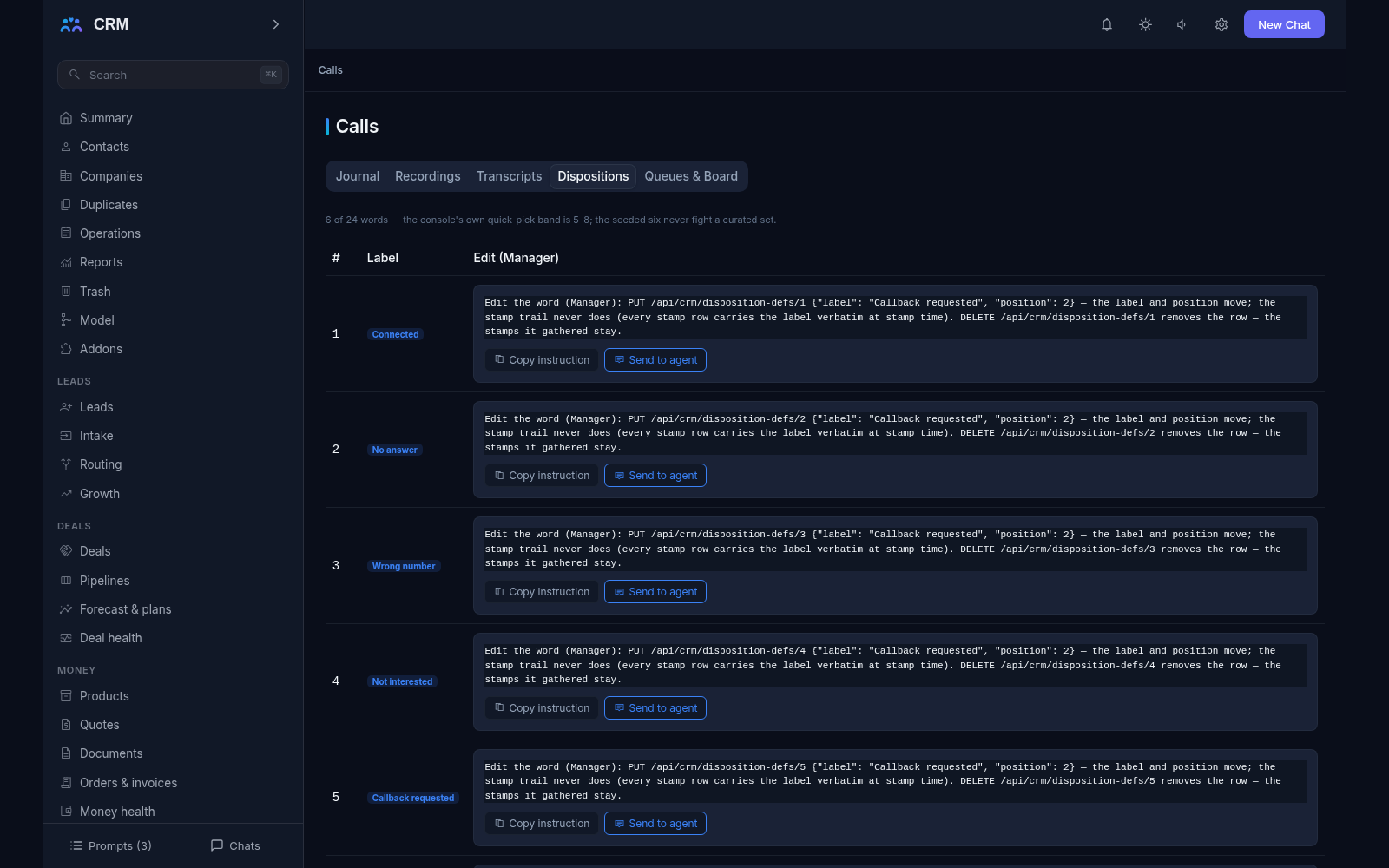
- The outcome of a conversation, with an edit history. A call has a result from a predefined set — for example, “reached”, “no answer”, “handed over to work”. The result can be corrected, but every correction stays in the journal: both words are visible, and who set them. Reports are built from the journal, not from “the last thing someone remembers”.
- Who is on the line. The board shows employees with their live status and the queue metrics computed from the journal: how many calls, how many missed, how many waited for an answer. No separately entered “indicators” — every number is derived from facts.
- Recordings with their legal part. A recording carries four mandatory notes: why it is kept, how consent was obtained, how the customer was told about it (a separate fact) and how long to keep it. The default retention is one month when the workspace language is Russian and three months when it is English; the ceiling is three years — past it the recording must be exported to your own storage. Listening is not open to everyone: only the management key, the workspace administrator and the employee who handled that conversation. Every listening is written to the access journal together with its purpose.
- Transcripts are drafts, not truth. A transcript of a recording is created as a draft and is never passed off as the correct text. Speech recognition ships in one form — manual: you paste or upload the conversation text yourself. A line the recognition marked as unintelligible or low-confidence stays marked through every repeated pass: the product “silently fixes” nothing, and a repeated request over the same recording is refused by name. Personal data — emails and phone numbers — is hidden at reading time according to the reader’s privacy settings, and the source text never changes.
- The outcome of a call is approved by a person. The AI agent may propose a short summary of the conversation, but it reaches the customer’s card only after a manager confirms it, and only once. This is the only record this add-on writes into the card; everything else is drafts.
- One workplace. The Calls console is made of the tabs Journal, Recordings, Transcripts, Dispositions and Queues & Board. It only reads: changes are made by agent commands, which can be copied straight from the interface.
How it relates to other add-ons
Telephony rests on Inbox: a call becomes a message of the one dialogue — one conversation, one record, keyed by the call number on the telephony station’s side. If Inbox is switched off, the product does not break: the call journal keeps writing to the client’s timeline, and the board simply loses its status column — no errors and no empty promises.
Listening to recordings rests on the Privacy add-on: it keeps the access journal. If Privacy is switched off, the right to listen is still checked, but no entries are added to the access journal.
Honest limits
- The product does not make calls on its own: it receives events from your telephony service and starts a call on that service’s command. What ships is the logging provider family — an honest minimum where every line’s device is visible. Real adapters to operators such as MANGO or UIS are named deferrals.
- There is no external speech recognition — only pasting or uploading a finished text. Identifying a person by their voice is deliberately out of scope: that function is not being built here.
- The product does not keep recordings for you: in one mode the recording stays a link in the telephony service’s storage, and the product only redirects to it. In the other mode the file is fetched to your own server — but then deletion by retention is irreversible: the file disappears together with its journal row, and cannot be restored.
- Deletion by retention is exactly deletion: every file that goes leaves a record that it went, with its notes preserved. The report “what and when we deleted” can therefore always be built — and what was deleted cannot be brought back.
- An already captured recording is never rewritten: a later channel edit or a refreshed link from the telephony service does not change the legal seats or the retention end date — they are copied at the moment the recording row is born.
- A transcript never becomes “the correct text” by itself: while a human has not confirmed the summary, nothing is written onto the customer’s card. If the call is not anchored to a customer, the confirmation is refused by name and the summary stays a draft.
- Search over transcripts obeys the same access right as listening: a colleague who neither took the call nor administers the workspace honestly gets an empty answer. The right does not depend on the searcher’s goodwill.
All add-ons → Add-ons catalogue